Traditional “old man” bars

One thing I love about Spain- particularly rural Spain- is the existence of what are termed “old man” bars. “Old man” bars are named after their clientele- they are generally populated by elderly men- and what could be called their “traditional” style. So, how can you identify an “old man” bar? And why are they good?

OK, to answer the first question, there’s a number of clues to look for:

  1. The decor is “rustic” and hasn’t been renovated for 30+ years. Entering such a bar is like taking a step back in time. Think bulls heads on the wall and hand-lettering.
  1. The coffee is torrefacto, and is served in a small glass. Torrefacto is a uniquely Spanish method of preparing coffee beans, which gives the product a rather unique taste (that’s putting it politely). “Old man” bars invariably serve torrefacto.

Photo from https://travelwritechange.com/tag/coffee-shops-spain/
  1. The food is incredibly cheaply priced and (usually) incredibly good. Just like the decor has been stuck in the 60s, so have the prices. Go to an “old man” bar, and you are likely to find amazing food at really good prices. Often, the chef will be the bar owner or his/her partner.
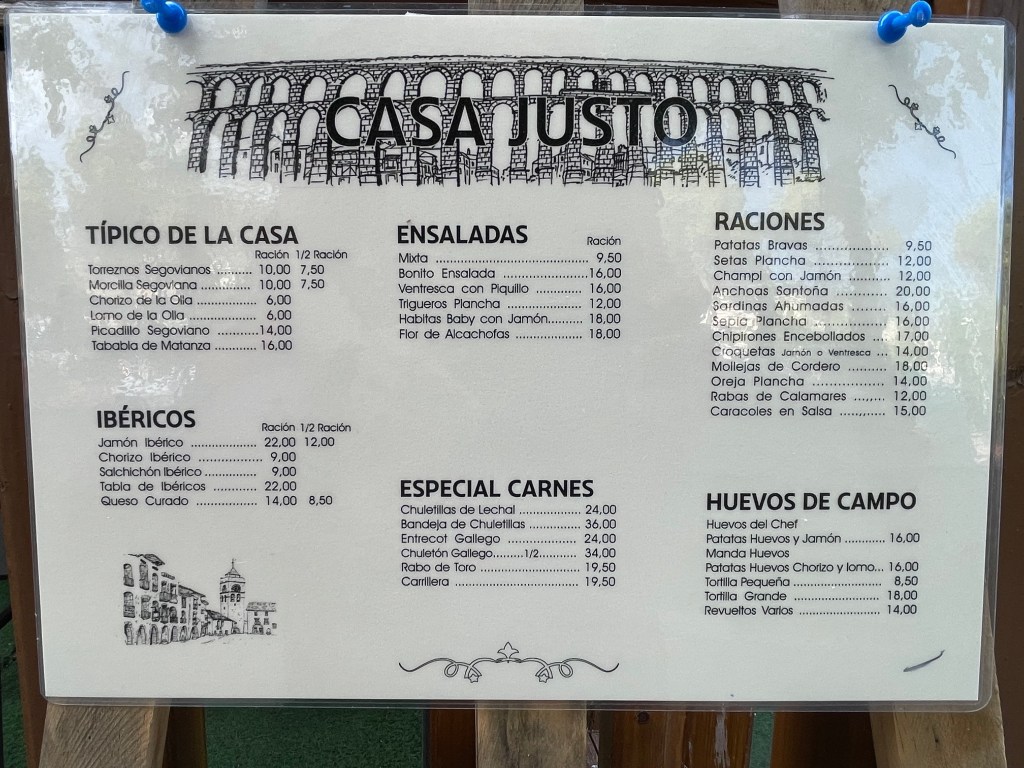
  1. The waiters are men in their 50s or 60s. One of the charms of “old man” bars is that the waiters are professionals. They come from an era where waiting was considered an honourable profession, rather than a way to make some spare cash whilst you’re at uni. Usually, the service is outstanding, and you’ll be called “usted.”
  2. It takes time to become a regular. But once you do, the employees and the other clients will defend you with their lives. When I was working at Los Negrales, I started frequenting an “old man” bar near my school. After about 6 weeks, the waiter realised that I was a loyal customer, and we started to chat. He told me when he saw a TV programme about Australia; another client introduced himself and his dog; and if I ever had to leave when the waiter was absent, I’d just tell the other clients that I had to return to work and I knew that they’d make sure the waiter got the money.

So, now we get to the second question- why are these bars worth preserving? In summary, “old man” bars are SO much more personal than the dreadful chains. Yes, you need to make an effort, and I respect that. But once you cross that threshold (and it’s hard, I know), the rewards are very high. You’re a member of a club that doesn’t admit anyone; that depends on loyalty and trust; and that doesn’t care about trends.

”Old man” bar with old man outside

And that’s something to be proud about.

August in Madrid

One of the most bizarre experiences that I’ve had in my life (and there’s been quite a few, let me tell you…) is spending an August in Madrid.

Above: Moncloa. Where IS everyone?!

Why? Well, the old adage about this city is “nueve meses de invierno y tres de infierno”, which translates to “nine months of winter and three of hell.” And August is the most hellish of these hell months. Think of Dante’s inferno. Think walking across scorching coals. Think of being inside an oven. And you still won’t even be CLOSE to imagining a Madrid August.

And I’m NOT exaggerating.

“You’re Australian! Why are you complaining about the heat?!” you may be saying. And fair point. However, the heat in Madrid is completely different to the heat in Sydney, where I’m from. It’s a dry heat in Madrid (👍🏻), but the problem is that it’s unrelenting- even at night, it’s 23 degrees. There is simply no respite. Add to this the fact that most houses/apartments are poorly insulated and/or lack aircon (I’m not joking), and you can understand why this place is a hellhole during August.

So, what do the Madrileños do? How do the locals cope with this hell? In a word- FLEE. In general, they will go to a cooler part of Spain (Asturias, Galicia, País Vasco), and spend the worst part of the heatwave there.

But here lies the conundrum…

Normally, Madrid is filthy, polluted, and overcrowded. However, during August, it’s none of these things. There’s no traffic. There’s minimal pollution. There’s no rush or bother. It’s absolutely wonderful.

Except for the heat.

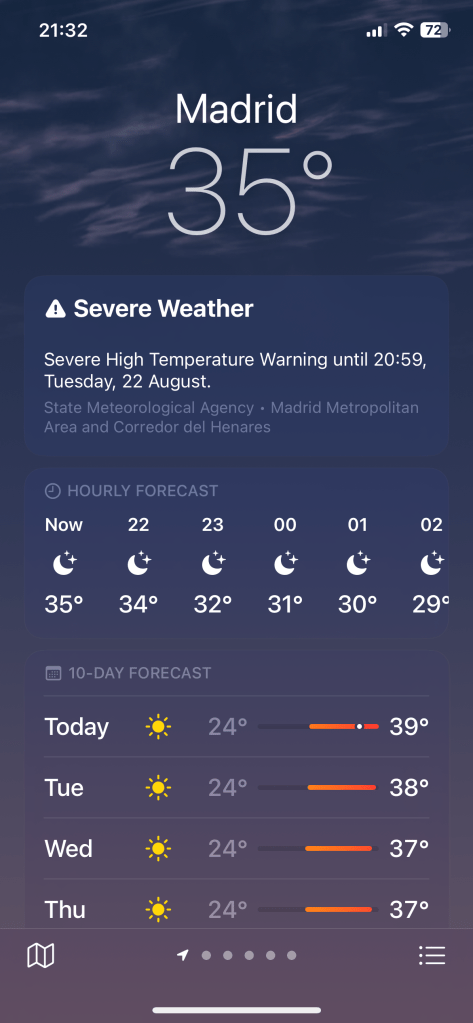
So what do you do? Enjoy the emptiness and the solitude, albeit constrained by the hellish temperature? Or should you flee like everyone else? I don’t know, but let’s just say, this forecast doesn’t fill me with hope!

Carnaval (and no, I haven’t spelt it wrongly!)

One of the (many) things I love about Spain is the interesting festivals that are held here. I particularly like it when said festivals are accompanied by a public holiday, and a day off school…

But I digress.

Anyway, next week is Carnaval, and preparations are already in full swing. According to the ever-reliable Wikipedia, Carnaval is a “festival of the libido” which occurs before Lent.

Perhaps unsurprisingly, when I first heard the word “Carnaval”, I imagined Brazil, and scantily clad dancers parading down the street to the sound of Latin music.

Carnival-Brazil-2016-Photos.jpg

But given that it was SNOWING in Madrid last week, bikinis are never going to be a part of the Carnaval here.

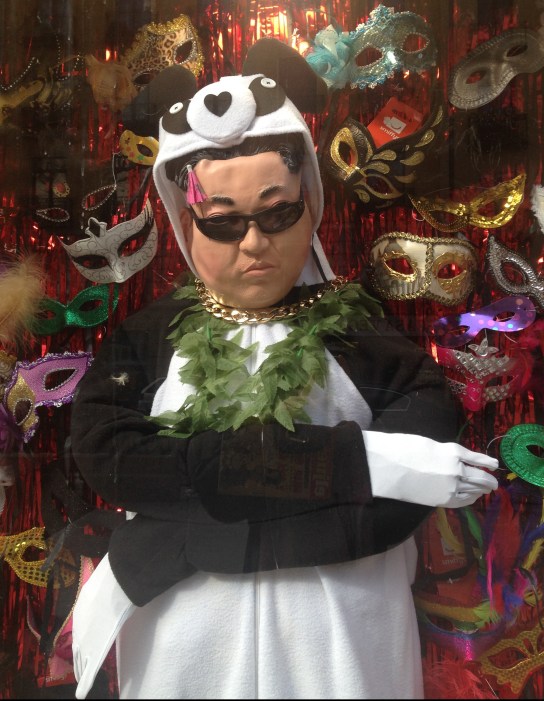
Instead, the carnaval involves getting dressed up in some kind of costume, and having a party. Costume parties seem to be extremely popular in Spain, and near my house, there is a very large shop which stocks all manner of disguises. Here’s a photo from today:

img_1949-e1518210065234.jpg

I’m assuming that it’s “supreme leader” Kim Jong-un, but I really don’t know. In a panda onesie. And gangsta sunnies. With a cocktail umbrella on the side. And hardcore arm folding. Plus a marijuana leaf lei. Talk about a bizarre combination…

(Aside- You’re not going to believe this, but the Kim Jong-un costume wasn’t even the strangest in the shop. That award was won by one of Mariano Rajoy, the Spanish Prime Minister, clad in a red lobster onesie, with a cigar in his mouth, and a skimpy shell bikini over the top. Dear god. The mind absolutely BOGGLES…).

IMG_2012.JPG

Anyway, at my school, the Carnaval celebrations are (comparatively) tame. On Wednesday, the students have to come in a disguise, which is different for each grade. For instance, the Grade 4 group have to come as artists, and the Grade 5 group as firemen, fire, water, or policemen.

But, for me, the best part of the Carnaval is the appearance of the peluche. Every day, in the week before Carnaval, the peluche gives the children “homework.” This homework is typically a bit naughty. For example, on Tuesday, the peluche told the children to wear something silly on their head. On Thursday, it told them to wear their socks in a funny place, so they turned up with socks on their ears. And so on…

The problem with the peluche is that, umm, it isn’t young (that’s putting it mildly). Rather, it appears to have been hanging around in a cupboard or similarly salubrious locale for, well, 20 years. After a few days sitting on its seat, it’s not looking its best. Rather, it appears ready for a visit (or, more precisely, a permanent move) to the nearest garbage bin…

Another of the more interesting aspects of Carnaval is the ritual burning of the paper sardine. After the children have paraded through the school in their costumes, someone brings out this gigantic paper sardine, covered in hundreds of carefully constructed scales. Each of the scales belongs to one of the kids, and on the back, they have written something they would like gone from the world e.g. war, bullying. At the finish of the celebrations, the sardine is burnt, and the bad things are “symbolically destroyed.”

It always amazes me that this symbolic burning proceeds incident free. It would seem to be asking for trouble to set a giant paper fish alight amidst a crowd of small children, but perhaps I’m too much of a worrier.

And I suppose, in the end, there was always the kids dressed up in the firefighter costumes to put out any unintended blazes…

Spanish New Year

One of the more intriguing contrasts between Australia and Spain is how the New Year is celebrated. Last year, I was in Portugal, so I wasn’t able to experience a genuine Spanish New Year. But this year, I was fortunate enough to be invited to spend the evening with a friend and his family at their home in Madrid…

Spain-Australia-Street-sign

At the beginning of the evening, things tend to be pretty normal. You sit around with the other guests, enjoying dinner and a few drinks, in the lead up to the big event.

Ho hum.

But at 11:45p.m., the preparations start in earnest. See, in Spain (unlike any other place on earth!), when the clock strikes midnight, there is a particular ceremony to be followed, namely The Ritual of the Grapes. The Ritual goes as follows:- as the clock rings each of its twelve times, the assembled multitude are required to eat a grape. So, by the end of the twelve chimes, you should have eaten twelve grapes. Each grape equates to a month of good luck, so eat them all, and you’ll have a lucky year.

NYE

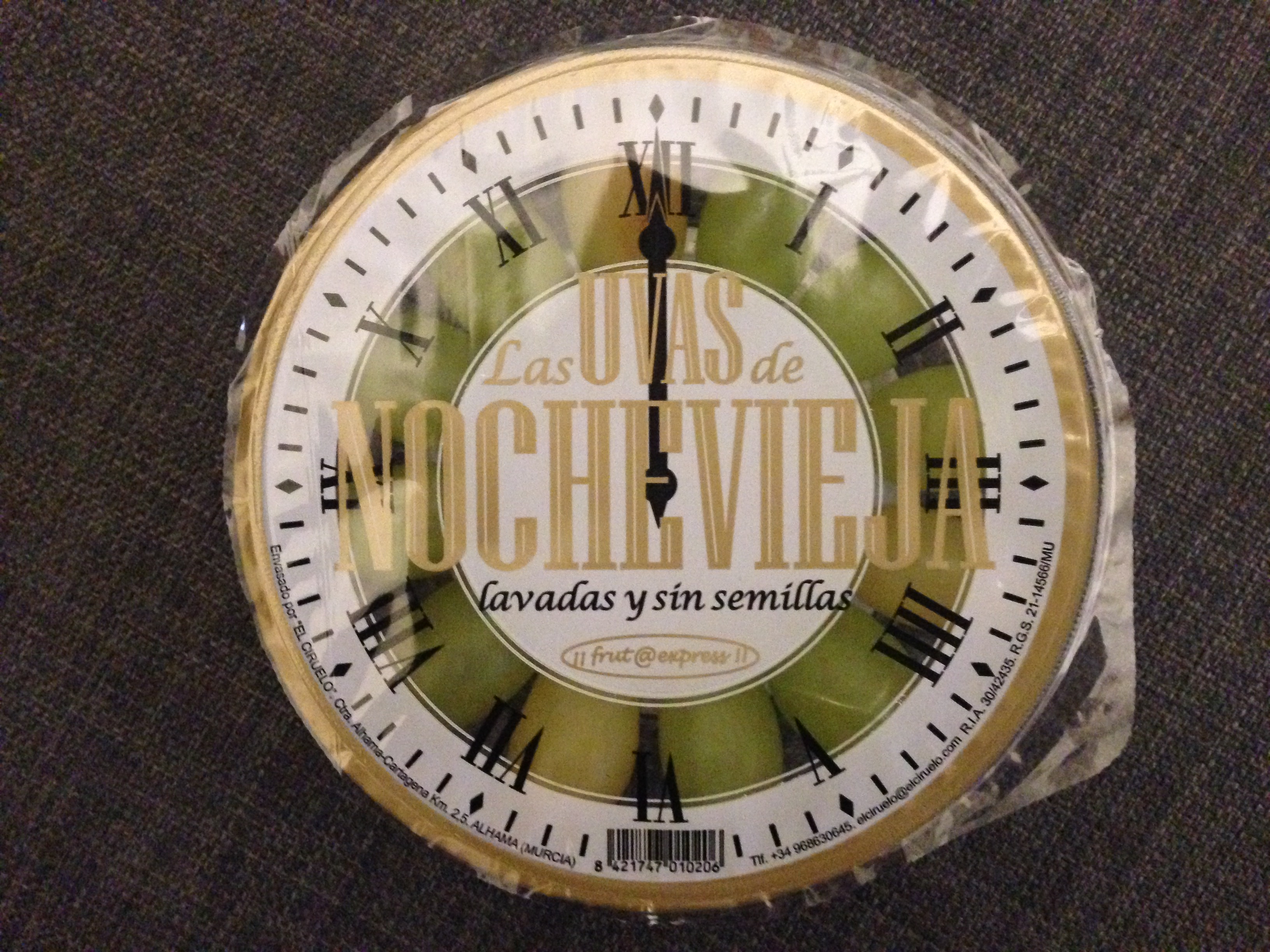
Now, let me assure you, having twelve grapes in your mouth is not as easy as it may look, especially when the official clock is chiming away every couple of seconds. For this reason, some people elect to “make things easier” (i.e. cheat) by peeling the grapes and removing the seeds, so that they “go down smoothly.” Or, if you’re REALLY lazy, you can buy a little packet of grapes, seeds and skin removed, and all ready to go when the time comes.

IMG_1786

This is how you can buy your grapes in the supermarket.

Seriously, this thing is a SCIENCE.

For my first year with the grapes, I was determined to have the genuine experience, seeds, skin, and all. As the clock approached midnight, I arranged my grapes, and prepared for the countdown (hosted on TV by a man who appeared to have taken style tips from Count Dracula- seriously, who on earth wears a CAPE nowadays?- and his glamorous assistant).

Ramón-García-con-su-capa-española-vuelve-a-las-Campanadas-de-TVE-junto-a-Anne-Igartiburu

At the first chime of the clock…nothing happened. See, for some bizarre reason, the official New Year grape clock in the Puerta del Sol chimes four times as a kind of warm up lap, before starting the official countdown. This is a trap for the unwary! Hold back, and don’t start eating the grapes before the TV tells you to!

IMG_1776.JPG

The official clock in the Puerta del Sol.

When it’s the REAL countdown, twelve grapes appear on the TV screen, and, with each chime of the clock, you eat one of your previously prepared fruits. The problem, I discovered, is that you don’t really have time to chew, so instead of eating the grapes, it’s more a case of storing them in your cheeks until you have time to chew them and digest them properly.

chipmunk-cheeks-filled-with-food

The whole thing is treated with the seriousness of a military campaign, and it was positively surreal to watch my friend’s dad, his sister, and his brother lined up on the sofa, eyes glued to the TV, and arms moving in unison to deposit the grapes in their respective receptacles on each strike of the clock.

Miraculously, I managed to insert all the grapes into my mouth without gagging/vomiting/choking/otherwise requiring medical intervention, which means that I ought to have avoided a year of bad luck. But whether this will extend to managing to avoid having to eat the grapes next New Year, I’m not too sure…

uvas_cinismoilustrad_2

Grapes 10-12- “You stop wishing, and concentrate on not choking.” If only this was a joke.